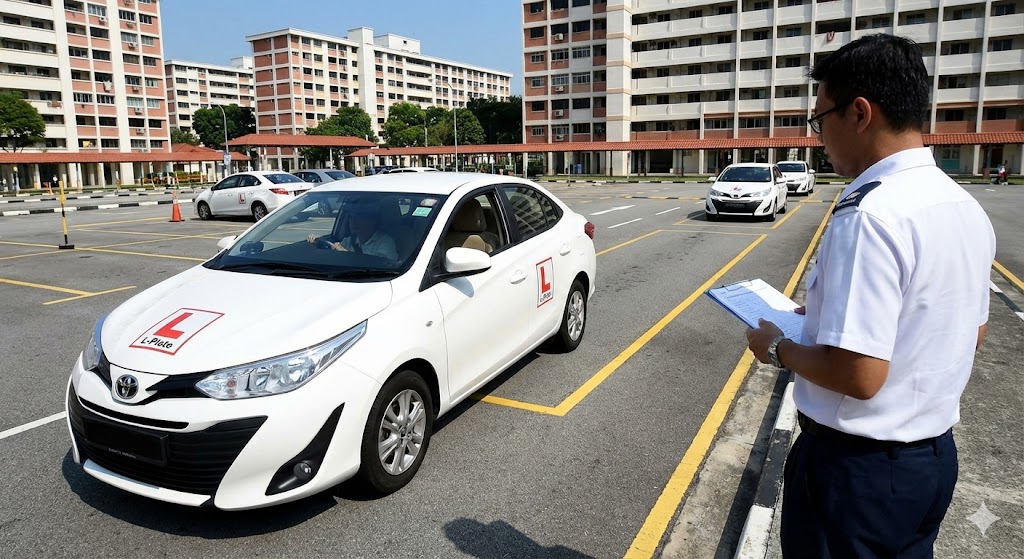
Nervous about your Traffic Police Practical Test? Learn the top “Immediate Failure” mistakes to avoid and expert tips to pass on your first try.
You have passed your Basic Theory Test (BTT). You have aced your Final Theory Test (FTT). Now comes the final boss: The Traffic Police (TP) Practical Driving Test.
In Singapore, the practical test is notoriously strict. A single mistake can end your test in seconds. This is called an “Immediate Failure” (IF).
At finaltheorytest.org, we want you to get your license on the first attempt. Here is the ultimate checklist of what not to do and how to impress your tester.
Understanding the Test Format
The test consists of two parts:
- Circuit Course: (Inside the driving centre) Parking, crank course, S-course, slope, etc.
- Road Test: (Outside on public roads) U-turns, lane changing, and general road safety.
You start with 0 demerit points.
- Minor mistakes (e.g., checking blind spot too late) cost 2, 4, 6, 8, or 10 points.
- If you accumulate 20 points, you fail.
- If you commit an Immediate Failure, you fail instantly, regardless of your points.
Top 5 “Immediate Failure” (IF) Mistakes to Avoid
Most students fail not because of points, but because of these instant killers. Memorize them:
1. Mounting the Kerb (Striking the Kerb)
This is the #1 killer in the circuit.
- Scenario: While parking or turning in the crank course, your rear wheel hits and climbs onto the kerb.
- Result: Immediate Failure.
- Tip: It is better to stop, adjust, and lose 2 points for “excessive changes” than to hit the kerb and fail instantly.
2. Failure to Check Blind Spots
Testers are eagle-eyed about this.
- Scenario: You change lanes or turn without physically turning your head to check the blind spot.
- Result: If it causes danger, it’s an Immediate Failure. Even if safe, it costs valuable points.
- Tip: Make your head checks obvious. “Wayang” (exaggerate) your movements so the tester sees them clearly.
3. Rolling Back on a Slope
- Scenario: On the slope test, your car rolls back more than a specified distance before moving forward.
- Result: Immediate Failure.
- Tip: Pull the handbrake tight. Rev the engine slightly higher (to 2.5k – 3k RPM) before releasing the clutch to ensure enough power.
4. Running a Red Light or Amber Light
- Scenario: Speeding up when the light turns amber, or failing to stop at a stop line.
- Result: Immediate Failure.
- Tip: When approaching a junction, lift your foot off the accelerator. Be prepared to stop, not to rush.
5. Causing Another Vehicle to Slow Down or Swerve
- Scenario: You change lanes aggressively, forcing the car behind you to brake.
- Result: Immediate Failure (Causing danger to other road users).
- Tip: Only change lanes when you can see the entire car behind you in your rearview mirror.
Secret Tips from Passing Instructors
1. Time Your Slot Wisely Avoid booking your test during school dismissal hours (1:00 PM – 2:00 PM) or peak hour traffic (5:00 PM onwards). The best slots are usually late morning (10:00 AM – 11:30 AM).
2. Greet Your Tester It sounds simple, but a polite “Good morning, Sir/Mdm” sets a positive tone. Testers are human; they appreciate respect.
3. Verbalize Your Actions If you face a hazard (e.g., a pedestrian jaywalking), say it out loud: “Pedestrian ahead, slowing down.” This tells the tester you are aware of the danger, even if you don’t stop completely.
Final Words
Nervousness is your biggest enemy. Treat the test just like another lesson. Drive safely, follow the rules you learned in your Final Theory Test (FTT), and remember: safety is more important than speed.
Good luck! We hope to see you on the road with your P-plate soon.